Thursday, December 17, 2015

Onward to Adventure: Chapter 3

The Ulurugg charged at our hero who quickly rolled out of its path, it would have been useless to try and hide from it now that he was spotted. The hero drew his axe and stood up to face the creature. It towered over him, steam shooted out of its nostrils, its hot breath felt overbearing, as the hero was used to the cold air of the cave.  The beast did its best to intimidate him, but our hero was unmoved.
The gargantuan monster raised a long arm and swung it at him, he dodged and swung at the monster.  With surprising agility, it dodged and jumped towards the hero.  The hero blocked its mighty fists with the halt of his axe.  The two were locked in a stalemate, each pushing on the other, snarling  and gritting their teeth.  Our hero looking more animalistic as the fight went on.  Our hero landed a successful slice at the Ulurugg, lodging his axe into its right arm.  The creature, now in a fit of rage ripped a stalagmite out of the ground and used it as a club of sorts.  The Ulurugg whacked our hero in his side, which sent him toppling to the floor.  
Things  were looking grim for him as the behemoth lumbered over to his body, clutching its right arm, it made a sound that was eerily close to a human laugh.  Suddenly, he realized how close his axe had fallen to him, in a swift motion he reached for his axe and dug it straight into its leg., the big blade bit deep into the beast’s thigh.  It let out a mighty roar, shaking the entire cavern, bits of rock were falling from the ceiling.  The creature clutched it;s side as our hero pulled the axe out and swiftly cracked it right into the creature’s back.  
At last, the Ulurugg was defeated, with a final ear splitting roar it exhaled its dying breath.  The hero sliced the massive head off of the now cooling body to bring back for his reward.  He exits the cave, carving as much useful materials from the corpse as he can carry beforehand.  The sky was now growing dark, as he exited from the mouth of the cave and the first hints of the night sky were beginning to show.  The long horned ants were chirping in the twilight and he could see the distant glow of the village he passed through in the morning in the distance.  Holding the head of the recent kill under his arms he says out loud in an exhausted voice, “All in a day's work.”.

Thursday, December 10, 2015

Onward to Adventure Chapter 2

The interior of the cave was dark and damp. The floor was clouded by a thick fog and anything could be underneath. Our hero took each step lightly and carefully as to avoid any traps that may still remain.  He heard the faint squeaking of cave mice and the fluttering of the leathery wings of the bats.  Other than that, there was silence, no dripping water, no wind passing through the holes in the ceiling of the cave.  Our hero felt unnerved by the quiet, he drew his axe, expecting the creature to jump out from the darkness.  He saw an opening to get deeper into the cave and walks through it.  There sleeping in the corner, on a bed of bones lies the Ulurugg.  
The creature stands on all fours and is about 7 feet tall, around 10 when it stands on its back feet.  It has large antlers that are stained at the tips from the blood of its last kill.  It has the face of a bear and it’s hind legs are also similar to those of a bear.  It’s forelimbs are long and it walks on its knuckles when it is on all fours.  The Ulurugg are known for terrorizing encroaching homesteads and will eat anything that tries to fight it.  It then drags the corpse to its cave to use the bones to ward off anything from going near its cave.
Our hero had to be very careful, the Ulurugg have a very keen sense of hearing and he had to try to kill it in its sleep, taking one on when it is awake is a foolish mistake.  One step at a time, he almost glides through the fog covering the floor of the room.  He got closer and the creature has yet to stirr.  Suddenly, he heard a high pitched, hurt squeak from underneath his boot, he has stepped on the tail of a mouse.  He lifted up his boot and the mouse scurried off into the skull of a deer in the corner of the cave.  
A low growl came from the Ulurugg, his long ears twitched, he heard the mouse and began to wake up. It rolled off of its makeshift bed and got on all fours,  Our hero swiftly ducked into the fog and remains still.  The darkness of the cave, combined with the shroud of fog should keep him hidden from the monster.  The Ulurugg lumbered around the room, trying to find the source of the noise.
Suddenly the monster stopped,  sniffed the air and stood on it’s back legs and beat its chest and let out a mighty roar that echoed like thunder inside the cave.  The monster looked in the direction of our hero and bared his teeth.  He then realized that the Ulurugg knew that he was there.

Wednesday, December 2, 2015

Onward to Adventure part one maybe?

It was a crisp autumn morning, he could tell by the cool wind that woke him up.  He left his window open the night before so that he could wake up early to prepare for his adventure.  He sprang out of his bed and ran into the main room of his cabin.  He packed his knapsack with his compass, his telescope, his journal, a pen, and a key to get back into his house.  He ate a breakfast consisting of bread and apple cider.  He took one last look around his house, and grabbed his axe on the way out the door.  And thus began our hero’s great adventure.

He walked along the path through the woods that connected his house to the main roads of the rest of the empire.  He looked up at the sky and saw that it was all sorts of vibrant yellows and oranges.  At last he saw the point where the path connected to the cobblestone road that would take him to his next. All the while, not pausing or slowing down, a face of sheer determination on his face.  As the morning sky fades into the blue of the day our hero sees  a village that the road goes through.

The village seemed to not really be anything special, standard one floor wooden houses with as he got closer, had traditional carvings on the pillars, carvings of dragons, bears, deer and fish, along with other animals that he could not yet make out.  As he got closer he could see people in the streets, men dressed in tunics with fur hats that covered their ears and foreheads from the mid morning chill that still lingered from the early morning.  Their black and brown boots which had a hint of tan from the dusty roads and alleyways that ran through and around the different buildings.  He saw them all rush to their jobs, our hero waved to the blacksmith,, the baker, the guards and the other commonfolk of the town.  They all knew him for his good deeds in the town, but no one stopped him, they knew that today was a very important task. He past through the town and got to the end where he saw the road fork to the left and right.

He veered to the right which lead up the black mountains, they are called the black mountains 

because of the high concentration of magnetite, the only remaining evidence  that this mountain was 

once an ancient volcano.  He got to the foot of the mountain and saw the mouth of the cave he 

needed to go in, a thin mist of fog emitted from it, skulls from other failed adventures, were sat on 

elephant tusks and lined the path to the cave.  The hero took one deep breath and walked into the 

darkness.

Wednesday, November 18, 2015

Miss Emily's Madness

First, I’m sorry I could not come up with a creative title for this post.

Recently in class we have been discussing feminist criticism and reading the short story “ A Rose for Emily”,  this story is about the life of this woman Miss Emily Grierson who refused to change with the times.  However, I will be looking at our dear Miss Emily through a psychoanalytic point of view.  The earliest point in her life that we are told about is the death of her father.  She at first is in complete denial and does not let the doctors take his body away fro three days.  She exhibits extreme denial,  which is a pathological defense mechanism,  it is understandable for her to have this reaction, as her father is now dead, however she reacts this way with every form of conflict.  Another time she does this is when the town goes to her to collect tax money, she simply repeats “ See Colonel Sartoris” who has been dead for some time.  Due to her using this defense mechanism we can deduce that she has snapped and that her father’s death could have been the cause of it.  I believe that there is a chance that this singular event is not totally to blame.  Also we learn that her father took care of everything in her life and taught her to think like the rest of her family, that they are ultimate beings and are better than every other person in the town.  So she for her formative years never really had to do much leaving her in a spoiled almost infantile mind frame.  

An interesting theory that I thought of about Miss Emily’s pathological tendency to revert to denial could be that she is a result of inbreeding within the family.  Now hear me out on this,  her great aunt Wyatt went crazy, it was also assumed that in turn Emily would go crazy.  Most people do not assume something if it only happens once, therefore other members of her family have more than likely gone crazy.  This makes her fragile mental state a genetic issue.  Her father it is noted, chased any suitor away from Miss Emily, on the grounds that she was too good for them.  The families weird arrogance and pride could then also be taken as that they are only people who were good enough for the Griersons were… the other Griersons.   Which makes Miss Emily an inbred, inbreeding within a family narrows the gene pool and makes the less desired traits more pronounced in a group, one of these such traits may be the mental instability that seems to run through the Grierson family tree.  

Thursday, November 12, 2015

Another Blast from the Past

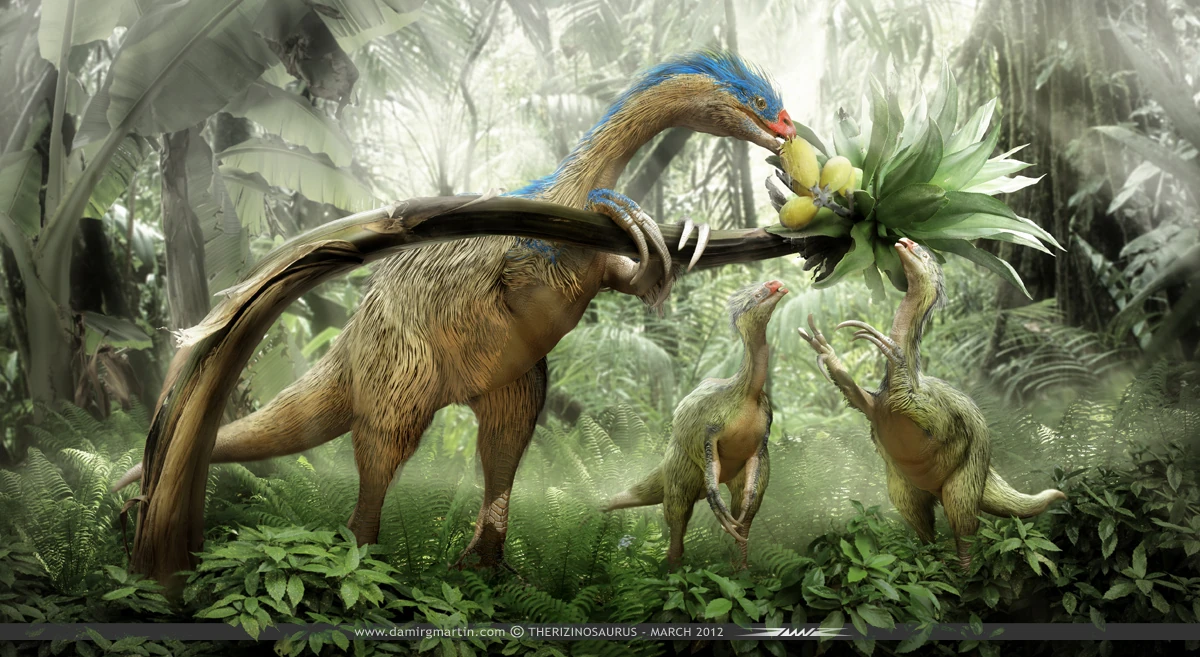
So, I’m not sure if I will do all of my blog on dinosaurs but a lot will probably be on them.  This is one of the more bizarre looking ones found in what is now Mongolia during the Cretaceous period, the last part of the age of the dinosaurs.  Therizinosaurus looks like if someone caught Big Bird on a bad day,  it was bipedal and had three long claws on each hand that grew to one meter in length.  It used these claws like how a sloth uses its claws, to strip leaves off of trees which at standing around six meters tall and nine meters long, was not a challenging feat.  So despite how intimidating it looked, it was strictly a herbivore which is why it evolved a long neck to reach trees and fruits.  While no complete skeleton exists of this species, they have been able to guess at what it looked liked based off of other members of the same family.  It walked on two legs and had wide bird like hips which gave it a broad body so it probably walked something like a duck.  Another unique thing about it’s skeleton is that it has four toes, most other theropods had three with the fourth two being a smaller toe on the side of its leg, so it having four evenly sized toes is very peculiar.  

However, this dinosaur was not a passive herbivore, its large claws were more than likely also used as a defense mechanism.  It’s large stature and long claws made it a formidable prey for any large carnivore in the area such as Tarbosaurus.  It’s body a patchwork of various dinosaurs probably allowed it to survive in various climates and seasons of the time.  Just like Dakotaraptor, Therizinosaurs was more than likely covered in feathers as well, making it look even more like a deadly big bird.  Despite being a herbivore, I would never want to run into the prehistoric equivalent of Freddy Krueger even if he was eating a salad, much like this guy.  

here is it compared to a human.
here is it in its hypothesized natural habitat.

Thursday, November 5, 2015

A Blast from the Past

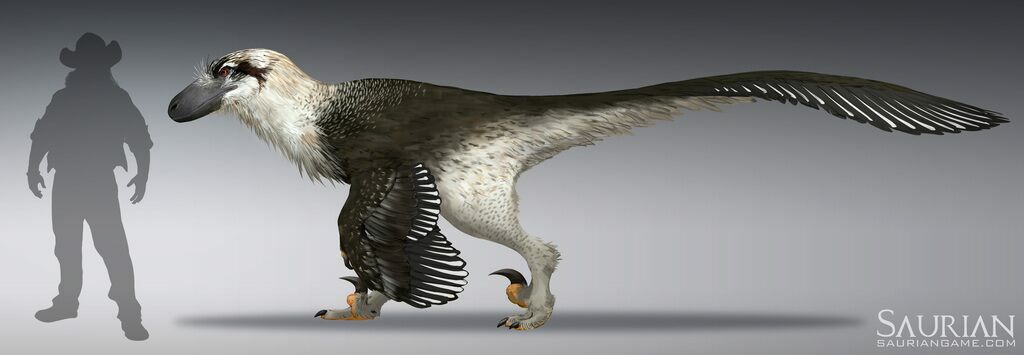
With this break in between lessons, I am going to take the time to talk about my favorite group of animals that have ever existed, that’s right dinosaurs!  They are the most diverse group of microorganisms that have lived, ranging from Microraptor, at a measly 16 inches, to Sauroposeidon with its head 59 feet off the ground.  However, no family of dinosaur is as known for its killing power as the raptors.  They have large claws and can outrun a cheetah,  the newest member of this species is the largest on record, Dakotaraptor. While new evidence shows that Velociraptor is not anywhere near as close to how it is portrayed in Jurassic Park rather it was a much smaller and more feathery creature. Dakotaraptor was around 16 feet long and lived in what is now the midwestern United States.  What is remarkable about this dinosaur is that despite its large size, it has true wings, which means that it was on the evolutionary pathway of flight.  However, since it was too large to fly, the mystery now is what the wings were used for.  I believe the wings were for attracting mates much like birds today, as well as possibly for intimidation against other large carnivores such as tyrannosaurus which lived alongside it.  This dinosaur, if it were alive today would be one of the most terrifying to live alongside as it was one of the top predators of its area and despite looking like a massive turkey, would send anyone packing.
here is a link to it in comparison to a human.

Thursday, October 29, 2015

One Teacher for Two Men


As we wrap up Winesburg, Ohio, we have encountered our first set of stories which tell the story of Kate Swift, George Willard’s old teacher.  Kate is first introduced in the story The Strength of God, where Reverend Curtis Hartman, a man married to a woman who has a repressed sexuality, which in turn makes him even more repressed views Kate as this gift from God.  He first sees her smoking a cigarette and lying on her bed.  The fact that she is smoking means that she is perceived by Curtis as having the control, cigars are of course a phallic symbol because why not, it looks sort of like a rod.  This sudden power she has over Curtis is shown in the passion that he uses in his sermons.  Also, he views  her through a chip in a stain glass window, the chip was on the heel of the boy in the window.  This shows that she is his Achilles heel, which means that she is his weakness, she completely takes over his mind without her knowledge.  It is not the actual nature nor appearance of Kate Swift that actually attracts Hartman,  we learn in The Teacher that she has a very unappealing figure and some form of skin condition.  Rather that if it was not her, it would be any woman.  Hartman believes that this is a test from God which means that he feels that she is divine which is an example of idealization, where he views his feelings as totally rational and that this is all okay.

In actuality, the real story behind Kate Swift is much more sad.  Similar to Wing Biddlebaum in the beginning of the book,  she has an urge to pull the greatness out from her students, she most notably noticed this spark when she had George Willard.  However, in her head, her want for emotional connection turns physical when she begins meeting with George Willard.  This makes her feel very conflicted, which is why Reverend Hartman sees her crying naked in her room.  George is ok with this and when she turns physical is ok with it.  However, the last time they meet, she embraces him and then comes to her senses and beat him and runs away.  George is now conflicted and feels as though he missed something that she was saying about him.  When in actuality, what he is missing is that she just wants to make him the best he can be and to help nurture his creativity.

Thursday, October 22, 2015

Wash Cannot Wash Away His Anger

Through the stories so far that we have read in Winesburg, Ohio, all the main characters of the stories have been a grotesque.  In this book, a grotesque is someone who lets an idea or truth of their life overcome them and become the only thing that they fixate on.  The character who goes through the most change because of his grotesque may be Wash Williams a man who was so committed and so loyal to his wife which eventually lead to his downfall.  Wash Williams is the only character so far who at some point treated his woman with respect, he did not have sex before he got married to her which shows incredible devotion towards her.  The language of this story leads us to also believe that they did not have sex together at all which leads her to cheat on him with several men in town.  There is a scene where his wife hands him the seeds to a garden while he does all the gardening.  This symbolizes the fact that his wife is in control of his manhood or his “seeds” which sounds really gross.  However, this shows that this relationship is almost flipped from the traditional married couples in the time period, where the woman is very submissive to the man.  Wash after learning of his wife’s infidelity simply sends her home to her mother’s, now what is interesting is that he sends all the 400 dollars to her and when he sells their house to him, he sends that money to her.  This shows how he is still submissive to her and even idolizes her.  Next he receives a message from the woman’s mother saying that she wanted to have him come to her house.  When he arrives he is presented with his former wife stark naked which enraged him, causing him to attack the woman’s mother.  

This hatred for his mother and law was never resolved, as she died of a fever a month after this encounter.  As this was unresolved, the anger towards her and her daughter, became a hatred towards all women.  This hatred towards all women is a form of projection where he directs his anger towards all women because he is unable to resolve his feelings with his wife and her mother.  Freud would view Wash’s passiveness and submissiveness as a form of an altered Oedipal complex where he possibly identified and sympathized with the mother rather than the father which caused him to get more feminine mannerism.  I argue that Wash is the most grotesque out of all those we have seen, this is because Wash’s trauma has him do a complete 180 degree turn in his behaviors and his appearance.  He seems to be the only character where what makes him grotesque effects more than just his mental ability.

Thursday, October 8, 2015

Paper Apples


In the story called “Paper Pills” from the book Winesburg, Ohio, we learn the sad backstory of Doctor Reefy and how he briefly married a woman before she died, from what, it never explicitly says but we are lead to believe that it was the truths that the doctor would read to her during the winter that killed her in the spring.  However, through the story of Doctor Reefy, we learn a lot about his wife, who is only referred to as the “tall dark girl” who inherited her father's large farm.  In this short story we learn that the tall dark girl had two suitors who stood out, both being polar opposites of the other.  One who only talks of being a virgin and the other who barely talks and tries to kiss her a lot.  With the “pure one” she has dreams where  he would hold her in his hands and where he bit her,  so she quickly abandoned that one, however, the other suitor the “black-haired boy” in real life gets her pregnant and bites her in the moment.

In literature, an apple is used to symbolize purity and when one is bitten it shows tainted innocence. In the tall dark girl’s dream, the jeweler’s son holds her in his hands like one would hold an apple and bites her, to show her fear of becoming impure from his lust.  On the contrary, the dark-haired boy actually bit her and got her pregnant, these two event happens happen at the same time to show that she has become impure by getting pregnant before marriage while the bite mark left on her shoulder shows the world what she has done.

In Winesburg, Ohio a gnarled or disfigured apple is said to have a sweeter taste than the regular apples.  The comparison to this is Doctor Reefy himself, while not being physically the most attractive man , he is described as having extraordinarily large knuckles which make the hands look disfigured like the apples that no one wants to eat.  Just like these apples Doctor Reefy has a very true inner beauty, which only the tall dark girl can see after going into see him for a checkup.  She could then not go back to the regular suitors just as those who eat the misshapen fruits cannot go back to eating the perfectly round apples.  This story provides two different meanings to what an apple can symbolize, one of true inner beauty and one meaning to be unclean.

Thursday, October 1, 2015

Freudian Trio in Pop Culture

 Sigmund Freud is known as the father of Psychoanalysis and rightfully so.  With his, quirks such as his obsession with sex and cocaine aside, he did a lot to further our understanding of the mind, whether it be what he directly discovered or finding out certain things that he discovered turned out to be false.  Freud discovered that there are three parts of the mind, the Id, Ego and Superego who all are in constant conflict with the other.  The Id, or as I personally enjoy calling it, the lizard part of the brain, this contains the most primal instincts for all animals to survive, the need to get food, reproduce, the fight or flight response as well as the subconscious urge to avoid pain and be drawn to pleasure.  The Superego is sort of like the parent to the Ego and Id, it strives for perfection and is a sense of extreme morality in the mind and is not as impulsive as the Id.  The Ego is the moderator between the two, it is a partially conscious part of the mind tries to find a medium to satisfy the Id and Superego.  His idea of these three aspects of the mind can be seen very commonly in popular culture.

These three aspects of the conscious are popular themes to play upon in T.V. shows.  Generally the three main protagonists of a show have one of the three parts of the mind as their prominent trait Garnet, Amethyst and Pearl are three caretakers for Steven in Steven Universe.  Garnet is the ego, she is calm and collected, she chooses sides with both Pearl and Amythest, just like the Ego, she is not totally without emotion but is not all instinct. Amethyst is the Id, she is out of control and causes trouble for Steven sometimes in their adventures.  Pearl is the Superego, she is very strict, she scolds Amethyst and sets the rules and expectations for the group, just as the Superego sets the rules for the person based off of what is socially acceptable for the person to do.  These three show the various types of defense mechanisms that the mind does based off of what it automatically reverts to.  Amethyst shows a lot of anger built up towards Pearl and then takes it out on others, which is displacement.  Garnet is very methodical and especially when she is exposed to conflict in the show, this is called intellectualization if it is not a conscious decision and is thought suppression if it is a conscious effort.  Pearl being the Superego, is very passive aggressive and uses guilt as defense mechanisms.  As much as Freud was off of his rocker on a lot of his ideas, some of his most successful works and ideas have lasted through the times in culture.

Thursday, September 24, 2015

Time Slips By

Since humans have been able to take note of the sun rising and setting we have found ways to measure time, distance and the temperature of the world.  Time out of these is the most abstract, as distance and temperature are physical changes in the environment, time can pass differently from person to person.  Try looking at a clock for one minute, it feels very slow right? However, during summer vacation, the days seem to go by so fast that they almost blend together.  The less you notice the passage of time, the faster it goes.  In dreams, hour pass by in a few minutes in “real time”.  The idea of time being a concept specific to one individual is shown very well in The Spot on the Wall, where a simple action of staring at a mark on the wall which in real time takes maybe a few minutes tops, is stretched out over what feels like hours, as she uses the dot to anchor herself as she jumps to different aspects of society, such as the rank of women in society and a need to feel balanced.  A classic example of time being relative is The Chronicles of Narnia where the children spend what feels like entire lifetimes in the imaginary world within the wardrobe when actuality they were gone not even a day.

The concept of time being an internal concept rather than external was coined during the period of Modernist Literature which lasted from 1915 through the 1950’s and made literature about very simple aspects of everyday life.  Again, The Mark on the Wall is an example of that, the simple normal event of contemplating what a mark you see on a wall is.  Modernism made literature once again about the common man and common things, rather than the extravagant tales of the past.

Thursday, September 17, 2015

The Height of German Efficiency

The height of German engineering in World War I was the introduction of the German U-boats in Atlantic warfare.  The submarine was first invented by Wilhelm Bauer in 1850, the three man Brandtaucher sunk to the bottom of Kiel Harbor on its first test run.  The first fully functioning submarine was built in 1903, Forelle, then was sold to Russia in the Russo-Japanese War.  The design, size and weaponizing of the submarine was upgraded and altered all the way through to the U-boat.  These included, diesel engines, torpedoes and torpedo tubes.  By World War I rolled around, Germany had almost 50 submarines of 13 classes either in commission or under construction.  The U-boat was ready to begin its terror of the Atlantic Ocean.

The U-boat quickly became a force to be reckoned with, sinking Ally ships quickly and efficiently.  The first merchant ship was sunk on October 20th, 1914, the SS Glitra off of Norway.  This was seen as retaliation against British blockades and landmines by the British.  The U.S. struggled to remain neutral with distress and frustration coming from the allied powers, the Allies then would fly the American flag in order to sneak past German U-boats which further angered the United States.  The false flags made U-boat strategies more ruthless and indiscriminate towards boats.  Even though the Lusitania was a tragedy for the U.S. it was not until the SS Sussex was sunk that got a mass reaction by the public.  The U.S. threatened to severe ties with Germany which made the Germans re-think their prize rules.  The German U-boats sunk 1.4 million tons of ship between October 1916 and January 1917 and on January 31, 1917 Germany announced that they would start unrestricted warfare which due to several U.S. merchant ships being sunk, the U.S. entered the way.  As the war came to a close out of 360 submarines built, 178 were lost and on November 11, 1918 the remaining submarines were surrendered to the Allies and were scrapped and researched in order to replicate the technology.

The end of World War I did not bring the end of the U-boat as many people believe.  The Treaty of Paris restricted the tonnage of the German navy.  They got around this by having facilities for building them and training crews be labeled as “research” and by the time World War II started, the Germans had 65 U-boats, 21 in the water, ready for war.  In the beginning the U-boats were super effective at destroying Ally ship, however as the war progressed, the Ally developed sonar to detect the submerged U-boats and targeted U-boat yards with strategic bombings.  The U-boat not only shaped war, it shaped the technology of the rest of the century, radar and sonar lead to the invention of cordless telephones and radio waves and the improvement of overall submarine technology improved greatly because of German engineering.